META ADS PERFORMANCE MASTERCLASS
Still spending more on ads just to keep sales moving?
If sales stop the moment you cut the budget, your ads aren't selling anything. Your ad spend is.
Same budget, same audience, someone else's ads take off
You need a standard for which ads to keep, which to kill, and when to scale.
Someone is selling to your customers in the same feed, for less.
Your customers don't care how much you spent on Meta.
All they decide is whether your ad stops their thumb
An ad that gets scrolled past in one second is an ad they never saw. You just pay for it.
This is not another Meta ads beginner guide
No "where is the button" tours, no glossary, no "just run it and see."
It's for businesses that spend on ads every month, know what one customer is worth, and win or lose big on a single scaling decision.
It's for people who want Meta ads to be a revenue engine, not a slot machine.
If you are spending on Meta ads right now,
keep reading.
When Meta ads stop working, almost everyone tries the same fixes.
Swap the creative
Narrow the audience
Raise the budget, then cut it
Rebuild the campaign
Switch agencies
Buy one more course
Put in more budget
Copy a YouTube hack
Repeat next month
And the moment the ads stop, sales stop with them.
But that's not the strangest part.
Nobody can explain why the ads that made money actually worked.
Even while a competitor keeps selling in the same feed.
"Meta is just luck."
"Run enough creatives and one will hit."
"Low ROAS? Turn it off."
What I watch is not today's ROAS number.
Not the 291% ROAS ad. Why we scaled the 278% one instead.
The standard you decide by is the money.
The real question is what you decide when you look at the numbers.
Most people who struggle with Meta ads go wrong right here.
- Kill an ad after one day of ROAS
- Raise the budget all at once when it works
- Change the audience first when it doesn't
- Copy the ad that's working as-is
- Not sure why it took off, or why it died
If three or more sound familiar, you're not bad at ads. Your decision standard was probably off from the start. And none of the agencies you paid ever told you what it was.
Numbers first, talk later.
Creative matters. Audience matters. Budget matters. You've heard it a hundred times.
That's not what I want to show you first.
Did revenue actually grow? Did efficiency hold when you scaled? Can you explain why?
That comes first.
We did not raise the budget big on day one.
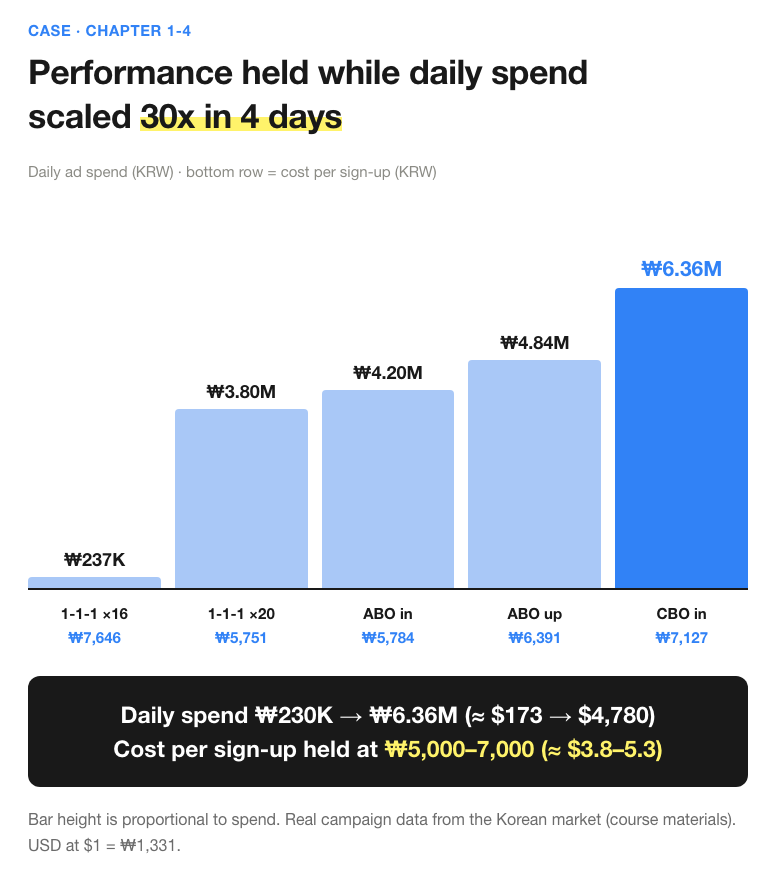
First we sorted out
which ads to keep,
which ad sets to kill,
and whether efficiency would hold as we scaled.
CASE 01
Daily spend ₩230K → ₩6.36M (≈ $173 → $4,780)
→ 30x in 4 days
We don't just look at how much we scaled.
We look at how efficiency held while we scaled.
Your customers are scrolling right now.
They didn't disappear.
They're stopping on your competitor's ad instead.
CASE 02
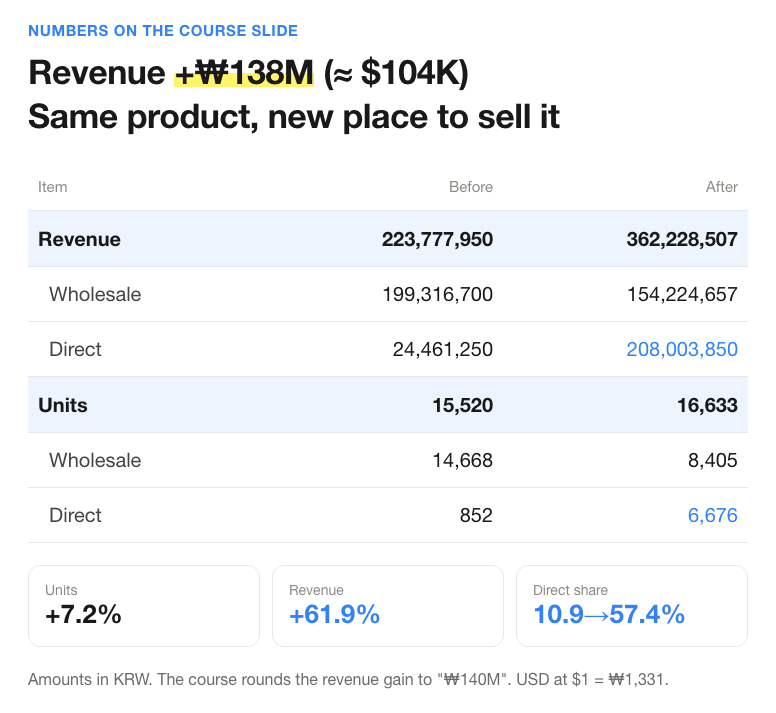
We touched the product, not the ad, and got 1,800% ROAS.
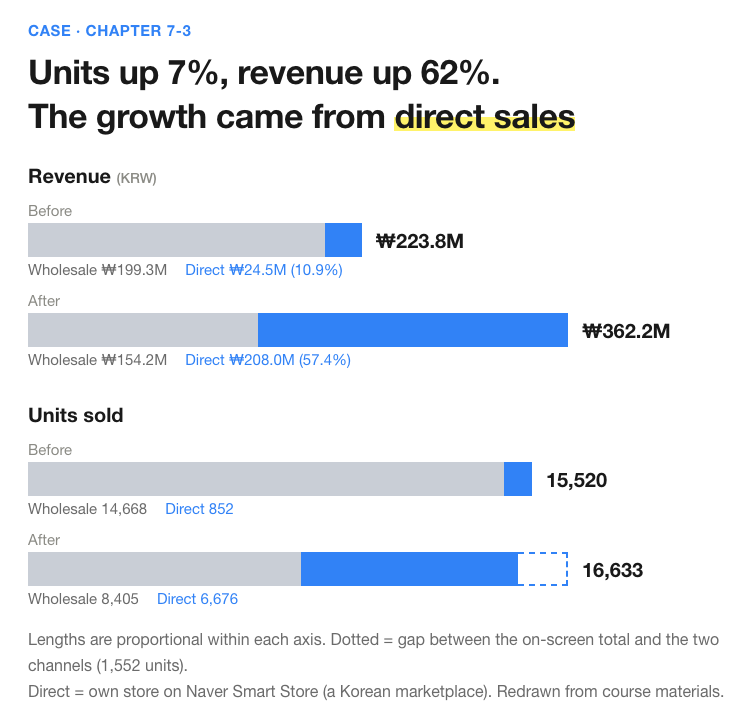
Instead of swapping creatives, we started with what was sold and where.
Revenue grew by ₩140M (≈ $104K) and margin improved by 15%.
Every other case is read the same way.
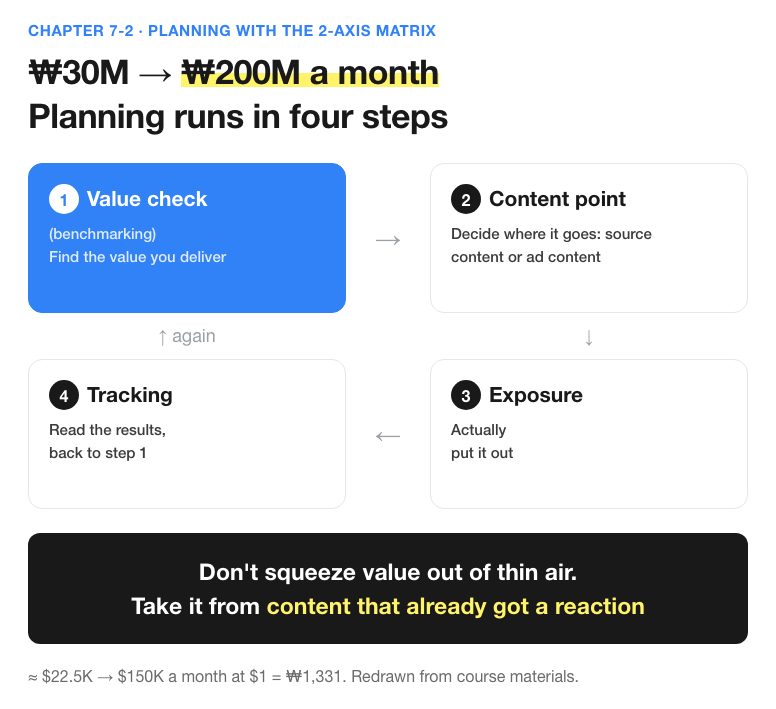
But one hit is not the point.
Anyone can get lucky with one creative.
What matters more to me is
"can you explain why it worked?"
Why you kept this ad
Why you killed that one
Why you scaled at this moment
Why you changed the campaign structure here
Whether you can make the same call on the next creative
If you can't explain it,
it isn't a strategy. It's luck.
Ask a Meta ads agency and you'll hear the same lines.
"Creative is everything."
"The algorithm needs a learning phase."
"Keep testing."
"Give it two or three weeks."
None of that is wrong.
But I always wanted to know what comes next.
So what did the ad that's selling right now actually do?
What creative is it running?
How long has it been live?
What hook stops the thumb?
How does the landing page carry it?
What price and offer did they attach?
Where in the funnel do people drop off?
How is the account structured?
Dashboard setup by industry
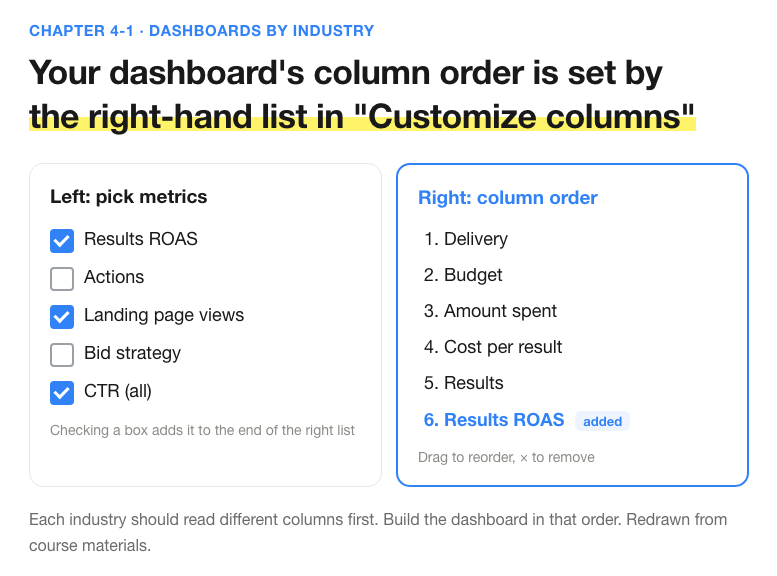
First, find where impressions, clicks and purchases break. A creative problem, a landing page problem, or a product problem?
Each industry should read different columns first, so we build the dashboard in that order.
Which ad, at which step, is leaking how much money?
The answer is already in your data.
Your ads have spent money and time writing the answer key for you.
Most people just never read it properly.
"So in the end, isn't it just about running more creatives?"
No.
100 creatives
50 Reels
30 UGC videos
AI images
Copy variations
Trending templates
Knowing every creative format doesn't make ads take off.
The first thing I check is one question:
Is this ad really failing because it needs more creatives?
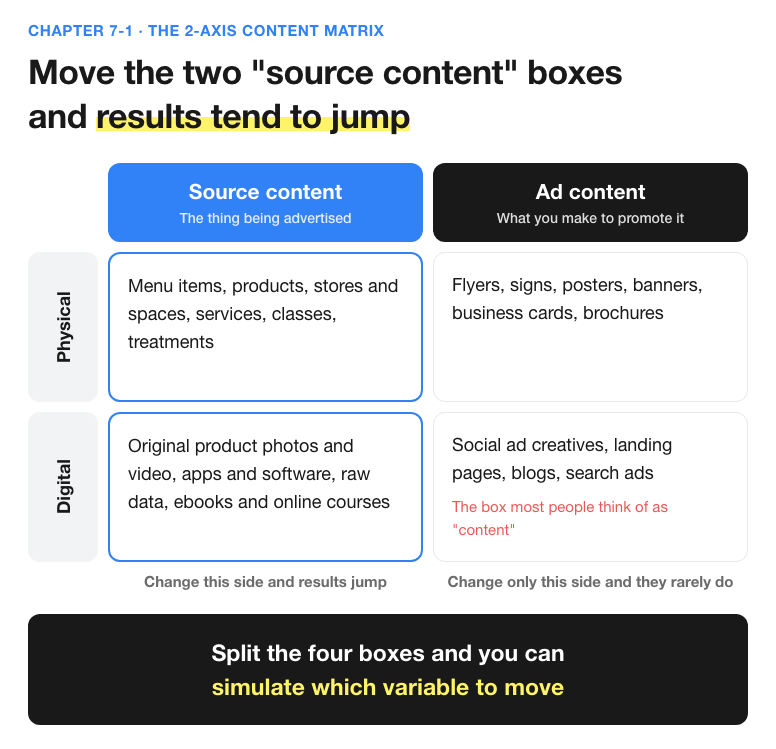
If what you sell or where you sell it is wrong, adding creatives first
doesn't solve anything.
You're just pouring more budget into an offer that doesn't sell.
I don't brag about volume.
Creatives 100
Campaigns 30
Reach 1M
If those numbers don't turn into revenue, they don't mean much to me.
Twenty campaigns that have nothing to do with a money decision
are not twenty assets.
They're twenty more campaigns to babysit.
"How many creatives did we run this month?"
matters less than
"How many dollars come back for every dollar of ad spend?"
While your ads aren't working, it isn't only ad spend you lose.
Customers who are ready to buy
go to your competitors, every day.
Have you been running ads without a standard?
That's normal. Most people have. Nobody ever laid the standard out for them.
So I wrote it down.
ROAS BIBLE
Meta Ads Performance Masterclass · Standard Edition
This is not a PDF that repackages Meta ads basics you can find online.
"What is a pixel?"
"The history of Meta ads"
"What is CPM?"
No pages padded with that.
What I wanted to put down is one thing:
what should you do with your ads, right now?
What matters is not what you learn. It's what you can decide afterwards.
Which ads to keep running
Which ads to kill
ABO to test, or
CBO to consolidate
All at once: one big scale-up, or
scale in steps
Sales campaigns to capture,
Leads campaigns to collect,
Engagement campaigns to warm up
What to check when efficiency breaks after scaling
A creative problem or a funnel problem
When to turn an ad off
How far to copy an ad that's working
What to change when results won't move
Meta ads are not a game of finding one lucky creative.
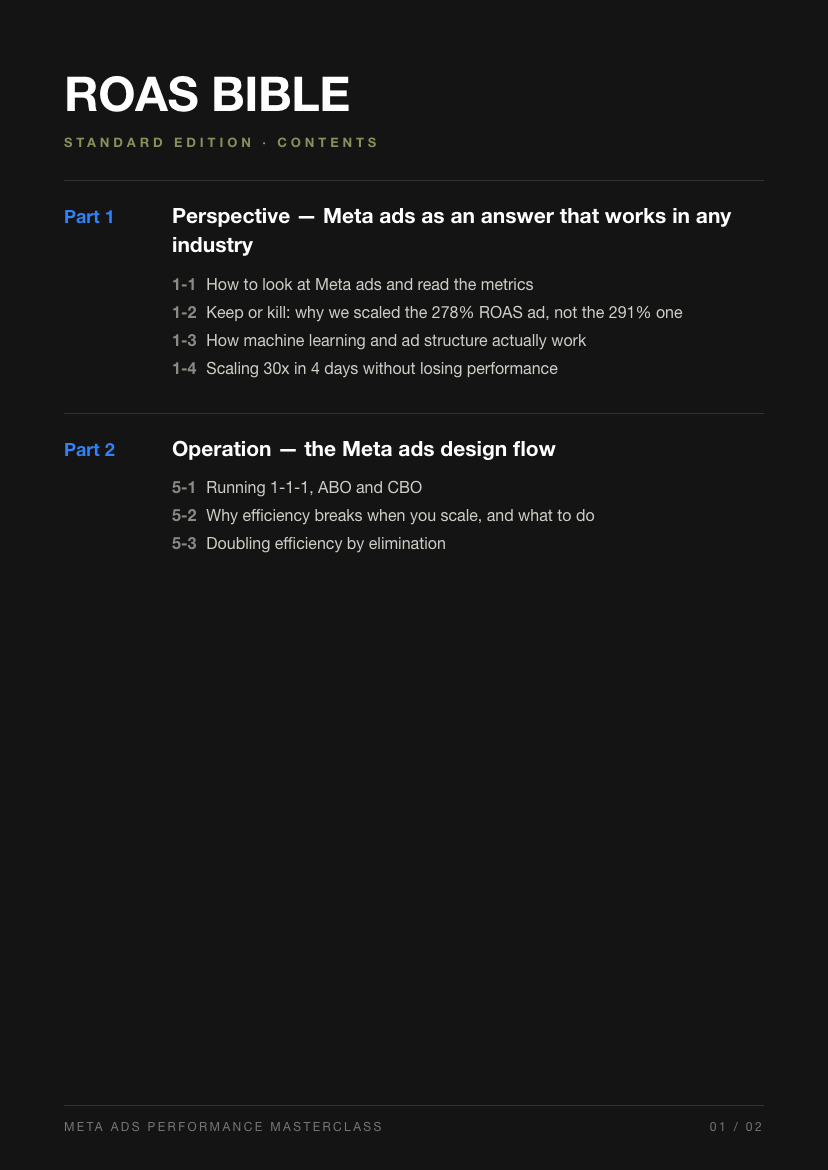
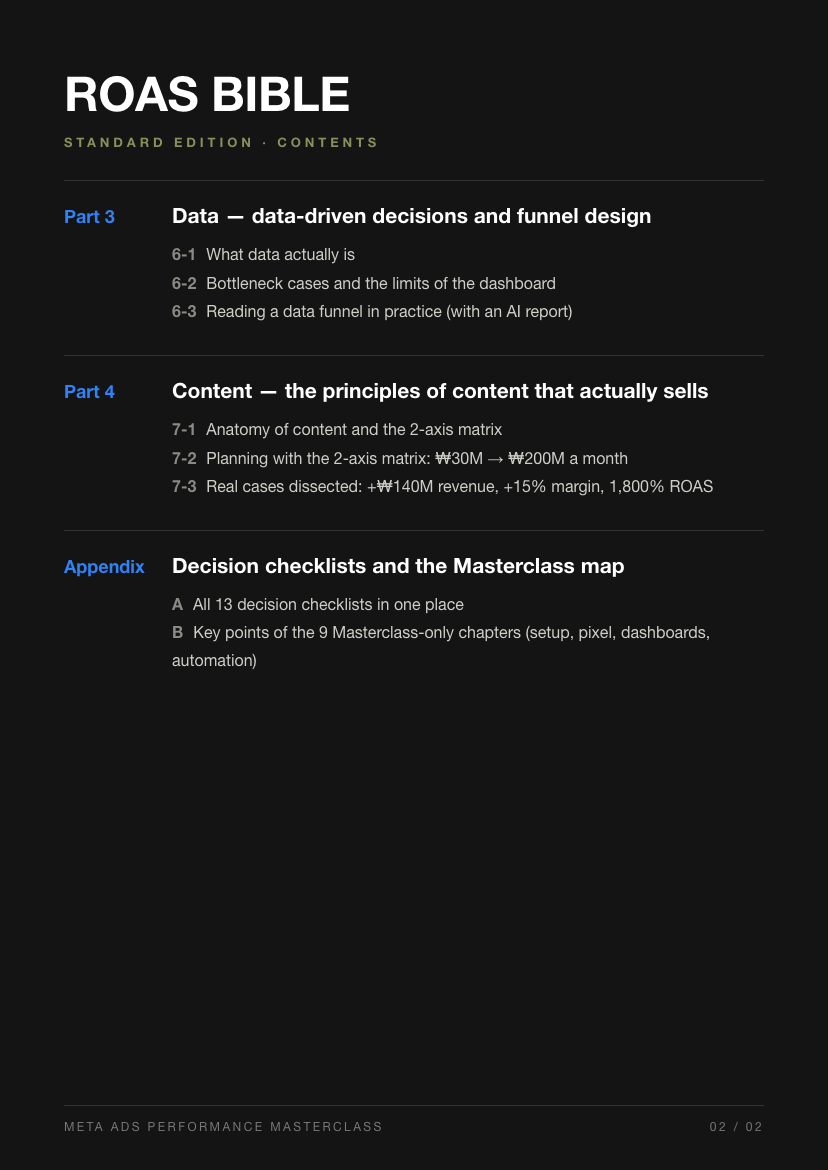
The real decisions, laid out in 13 chapters across four parts.
Money leaks out of Meta ads not because you don't know how.
It's because you kept doing it the wrong way for too long.
I can show you the numbers.
Revenue +₩140M (≈ $104K) ROAS 1,800%
But what I really want to show you is not the numbers themselves.
It's whether you can explain why the ad kept selling.
Let me be clear about one thing.
Not every ad will take off.
Some ads you build will need to be killed.
Some products take longer than you hope.
Some markets are so crowded that the right call is not to advertise yet.
So I will never say
"Guaranteed to work."
"1,000% ROAS guaranteed."
If anything, the core of this book is
killing what doesn't work, fast, and putting money and time where the odds are highest. That's the method.
What it means to hand off your Meta ads
I'm not telling you not to use an agency.
In a competitive market,
shooting, design, operations, outsourcing —
sometimes you need experts.
But at the very least,
shouldn't you know why you're paying for it?
"We ran 30 creatives this month."
Is that good?
"We rebuilt the campaign."
Why did you rebuild it?
"It's the learning phase, let's wait."
Why do we need to wait?
"ROAS was low, so we turned it off."
Then why did you start with that ad?
If you can't answer and you're only paying,
you're not running ads.
You didn't hand off your ads. You handed off your judgment.
If you think this is "just a PDF," don't buy it.
If all you want is a PDF file, it's expensive.
There's plenty of free Meta ads information.
On YouTube.
On blogs.
Ask ChatGPT and it will explain the basics of Meta ads.
What I'm selling is not Meta ads information.
It's the standard for
what to keep,
what to kill,
what to make,
when to scale,
and which data to read before your next decision.
All written down.
The most expensive thing in Meta ads is not the price of this book.
Spending three weeks on an ad that won't work.
Pouring 100 creatives into a product that doesn't sell.
Not knowing efficiency will break, scaling all at once
Not knowing why it isn't working, trusting the agency and waiting a few more months.
That costs far more.
I won't tell you this book doubles your ROAS by tomorrow.
Instead,
I wrote it so you can stop spending money without knowing why it isn't working. That's the goal.
The same customer's feed has limited room.
If your ad isn't running, that spot isn't empty.
Another brand is taking it.
Not an ad that hits once by luck and then dies,
but an ad that keeps selling when you scale.
That starts with learning how to read your ad data.
ROAS BIBLE
Meta Ads Performance Masterclass
· Standard Edition
$39
One-time payment · PDF + web reader